
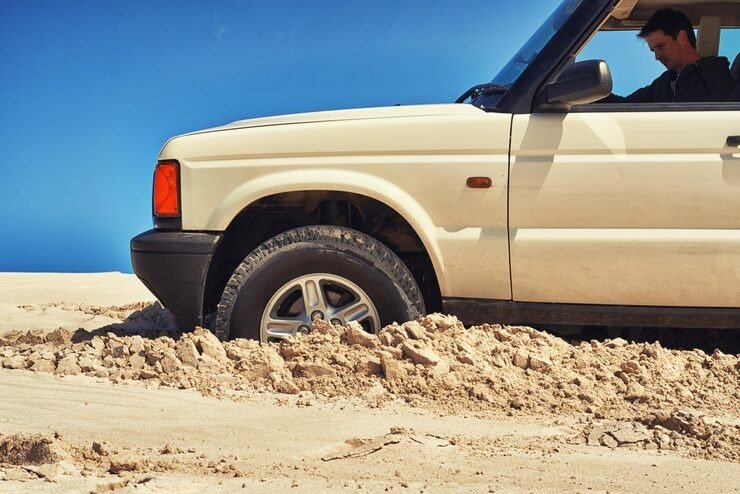
Date: May 28, 2026 | By Desert Safari Dubai
There’s a moment — every desert newcomer feels it — when the tarmac disappears beneath your tyres, and the golden dunes take over. Suddenly, everything you thought you knew about driving evaporates. The grip’s gone. The steering feels vague. The throttle responds differently. Welcome to sand driving, where the rules rewrite themselves every meter.
Whether you’re planning a desert safari in Dubai, curious about a dune buggy experience, or simply wondering why your mate keeps raving about swapping tarmac for sand — this guide breaks it all down. Practically. Honestly. With zero fluff.
Most drivers spend their lives on tarmac. It’s predictable. Grip levels are consistent. Brake, and the car stops. Steer, and it responds. That predictable response is something we take for granted — until it vanishes.
Driving on sand flips every assumption upside down.
| Feature | Tarmac Driving | Sand Driving |
| Surface grip | High, consistent | Low, inconsistent traction |
| Steering response | Immediate | Delayed response, vague steering |
| Braking distance | Short, predictable | Significantly longer |
| Acceleration response | Direct | Requires measured throttle |
| Vehicle weight impact | Minimal | Critical — affects sinking |
| Tyre pressure | Standard | Reduced tyre pressure needed |
| Ideal vehicle | Any road car | 4WD / off-road specialist |
On a race track, the surface is engineered for performance. Think of the Abu Dhabi Grand Prix circuit — smooth, rubber-laid, designed to maximise grip. Your car bites into it. Every throttle input lands clean. That’s circuit driving at its finest.
Sandy terrain operates by entirely different physics. Loose sand shifts beneath your tyres. Instead of biting in, the rubber floats — or sinks. There’s no consistent anchor point. The difference between sand and circuit performance isn’t just dramatic — it’s humbling.
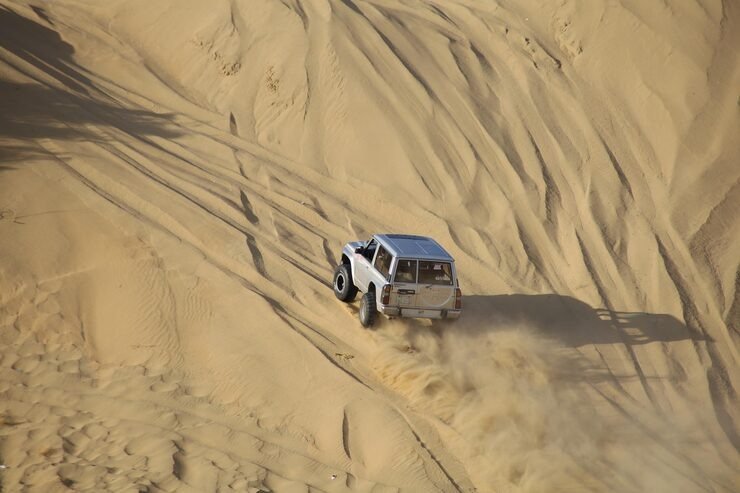
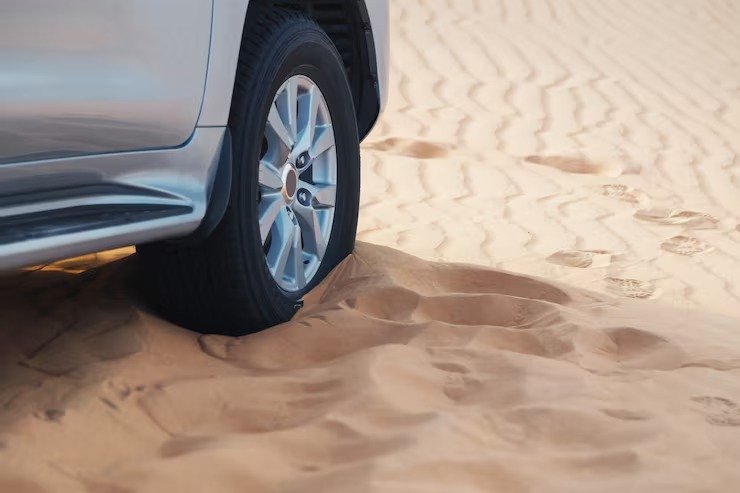
Here’s something that surprises most first-timers: your tyres don’t grip sand the way they grip tarmac. On a hard surface, the tyre’s contact patch bites into the road. On loose sand, the same tyre sinks in — or worse, spins uselessly on top. Understanding how tyres interact with different surfaces is fundamental — and sand is the most demanding surface of all.
Rolling resistance is the enemy. Sand creates enormous sand drag, forcing your engine to work far harder just to maintain speed. That’s why engine power and torque matter so much more in desert driving than on any road. Off-road tyres with deep tyre grooves help channel loose sand away from the contact zone — but even the best rubber behaves differently out here than it does on tarmac.
The solution? Reduced tyre pressure — typically between 16–20 PSI for sand driving. Lowering the pressure increases the tyre contact patch, spreading the vehicle’s weight across a broader surface area. The tyres float on sand rather than digging in. It’s counterintuitive — but it works brilliantly.
“Lower your tyre pressure before you hit the dunes. It’s not optional — it’s the single most effective adjustment you can make.” — Expert desert driving instructor, Dubai.
Vehicle weight plays a starring role on sandy terrain. A heavier vehicle sinks deeper. Load distribution shifts constantly as you climb and descend dunes, altering handling in ways tarmac drivers never experience.
Four-wheel drive distributes power across all four wheels simultaneously. That’s why an air-conditioned 4×4 remains the benchmark choice for any serious desert safari — it manages weight distribution off-road far more effectively than a two-wheel-drive vehicle ever could.
Forget the vague advice. Here’s what genuinely experienced desert drivers do differently.
Before anything else — drop the pressure. 16–20 PSI is the generally accepted range for soft sand. This single adjustment transforms vehicle dynamics, dramatically improving sand tyre grip and reducing the risk of getting stuck in sand.
This one surprises people. On sand, high gear, low RPM is the formula. Why? Because high RPM causes wheel spin — and once those tyres start spinning, you’re digging yourself into a hole. Literally.
Wheelspin prevention comes from smooth, steady power delivery. Keep the revs low. Let the torque do the work.
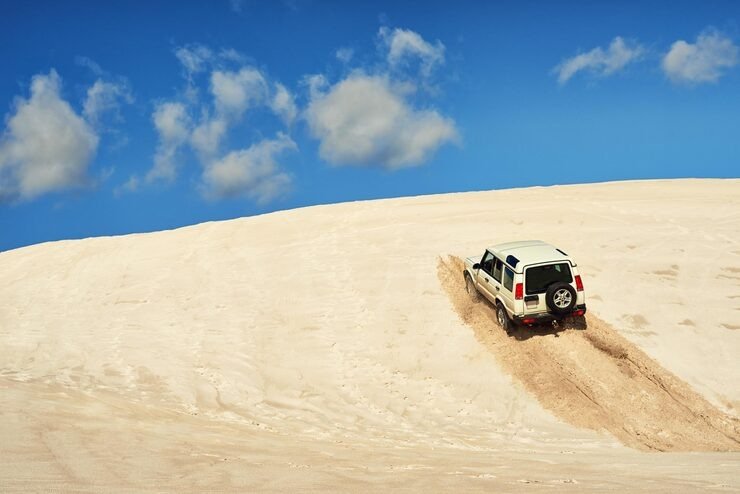
Momentum is everything in off-road driving. Lose it, and you’re fighting rolling resistance with a stationary vehicle — a fight you’ll rarely win. Maintaining speed through soft sections, using momentum, not power, to carry you through, is a core principle of sand driving techniques. Getting your vehicle speed right — not too fast, not crawling — is the sweet spot every experienced desert driver learns to feel.
Harsh inputs are the fastest route to losing control. Measured throttle, smooth steering on sand, and gentle braking on sand are the golden trio of sand terrain control. Think of it as playing a long game — every input smooth, deliberate, and considered. Your braking response on sand feels nothing like tarmac — expect longer distances and less bite, so always brake earlier than instinct tells you. When turning, favour smooth turns and wide arcs rather than sharp pivots. Sand punishes aggression instantly.
Avoid sudden acceleration. Avoid sharp turns on sand. Avoid harsh braking on sand. These aren’t suggestions — they’re the difference between a thrilling ride and getting bogged down.
Desert terrain navigation starts before you move. Study the dune. Identify the wind direction — it tells you which slope is firmer and which is the loose, crumbling slip face. The firmer slope is always the windward side. The slip face features a sharp drop-off that can catch even experienced drivers off guard.
Always approach head-on. Never hit a dune at an angle. Vehicle rolling and sideways sliding are serious risks when you approach at anything other than straight on.
The dune crest is the most dangerous point of any climb. Dune crest visibility is zero until you’re on top. Slow down as you reach the dune crest. If anything’s on the other side — another vehicle, a steep slip face, a sharp drop-off — you need time to react.
Crest with caution. Always.
Coming down is equally demanding. Dune descent control requires:
Sand driving for beginners often involves the same handful of errors. Recognise these before you head out.
Getting bogged down is the most common. It happens when drivers panic, apply too much power, and spin their way deeper into the sand. If you feel the vehicle slowing and sinking — ease off. Don’t hammer the throttle.
Loss of control on sand typically follows sharp steering inputs or sudden braking on a slope. Remember: vague steering is normal on sand. Don’t overcorrect.
Vehicle stuck in sand situations call for sand-recovery techniques — deflate tyres further, engage low-range 4WD, and use reverse to back straight onto firmer ground where possible.
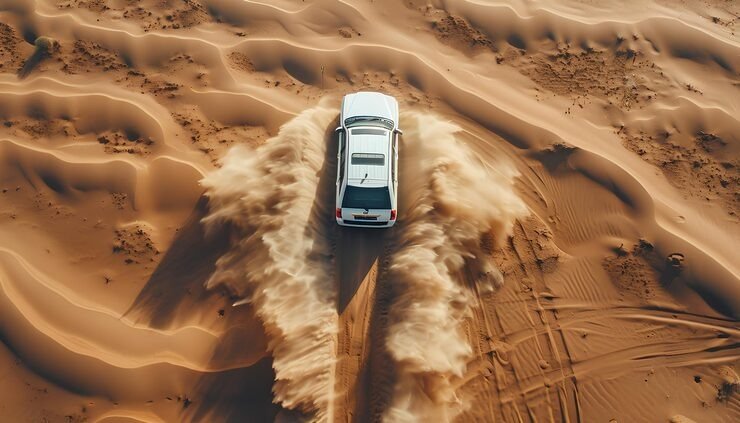
Reading about dune driving is one thing. Feeling it beneath you — that’s something else entirely.
Sunset Evening Safari offers Dubai’s most trusted dune buggy experience, guided by expert local instructors who know these red dunes intimately. With a zero safety incident record, a 5.0 rating, and over 10,000 happy guests, this isn’t just a tour — it’s a masterclass in dune riding delivered safely, memorably, and brilliantly.
From air-conditioned 4×4 safaris to hands-on Dubai dune buggy rides, every experience includes a thorough safety briefing from a trained driving instructor. You won’t be thrown in at the deep end. You’ll be guided, supported, and thrilled — in that order.
Book your desert safari in Dubai today →
A dune buggy Dubai session is the purest expression of off-road driving. Lightweight, powerful, and purpose-built for sandy conditions, these machines transform the dunes into a playground.
A quality guided dune buggy experience includes:
Booking a dune buggy experience in Dubai is straightforward — but choosing the right operator makes all the difference. Arabian Adventures’ dune buggy sessions and experiences, such as The Fort Lisaili Dubai, have set the benchmark in the UAE. The combination of off-road vehicle control, stunning Dubai desert landscape, and expert guidance makes these sessions genuinely unforgettable.
Here’s a name petrolheads will recognise — Guenther Steiner, the former Haas F1 team principal and beloved Drive to Survive personality, has brought a unique motorsport energy to Dubai’s desert adventure scene. The Guenther Steiner Dubai event at The Fort Lisaili blended the worlds of F1 desert events and authentic desert adventure — complete with a VIP meet-and-greet, a BBQ buffet, a desert dinner, and a spectacular fire show.
It’s exactly the kind of crossover that captures what makes Dubai’s motorsport desert experience so unique — where swapping tarmac for sand isn’t just a metaphor. It’s the entire point.
Racing circuits vs desert driving reveal a fascinating contrast. The Abu Dhabi Grand Prix showcases circuit driving at its peak — engineered tarmac, maximum grip, ultra-predictable vehicle response. Drivers push to the absolute limit because the surface allows the tom.
Sand demands the opposite philosophy. Tarmac grip levels give drivers confidence to attack. Low traction and inconsistent traction on sand demand restraint. The fastest desert drivers aren’t the most aggressive — they’re the most measured.
That race-circuit comparison tells you everything about the desert-driving mindset: precision over aggression, patience over power, steady momentum over raw speed.
| Experience | Best For | Highlights |
| Evening Desert Safari | Families, first-timers | Sunset dunes, cultural immersion, BBQ dinner |
| Dune Buggy Dubai | Thrill-seekers, petrolheads | Active driving, speed, hands-on control |
| 4×4 Desert Safari | Groups, all ages | Comfort, expert guidance, dune bashing |
| Overnight Desert Camp | Couples, adventurers | Stargazing, full desert experience |
| VIP Private Safari | Luxury travellers | Tailored routes, exclusive service |
Every experience listed above is available through Sunset Evening Safari — Dubai’s most trusted name in desert safari adventures.
Desert safari tips for first-timers visiting Dubai:
The dunes are waiting. And honestly? No amount of circuit driving or track driving prepares you for that first rush of dune descent control, the silence of the Arabian desert, and the satisfaction of cresting a dune cleanly.
Sunset Evening Safari makes it accessible to everyone — from complete beginners to seasoned off-road enthusiasts. With eexpert-traineddriving instructors in Dubai, zero safety incidents, and experiences ranging from budget-friendly group safaris to exclusive VIP packages, there’s genuinely something for every type of traveller.
Explore all experiences and book your desert adventure today →
Driving on sand and driving on tarmac aren’t just different surfaces — they’re entirely different disciplines. Tarmac rewards aggression and precision. Sand demands patience, finesse, and respect. Understanding vehicle dynamics, mastering tyre pressure for sand driving, reading dunes correctly, and applying gentle inputs separate the drivers who thrive from those who get bogged down.
Whether you’re drawn by the thrill of a Dubai dune buggy ride, the magic of an evening desert safari, or the unique buzz of a motorsport desert experience, the red dunes of Dubai offer something no race circuit ever can — raw, authentic adventure, written in sand.
And when you’re ready to experience it properly, Sunset Evening Safari — operated by Sunset Dream Tourism LLC, Al Khabeesi, Dubai — is exactly where that adventure begins.
10,000+ guests. 5.0 rating. Zero safety incidents. One unforgettable desert.